PCE Services
Screw Compressors
With decades of experience; and the right attitude, equipment, expertise and OEM parts, your screw compressor gets the right attention and service.
Talk To An Expert Today!
Servicing all leading brands.
Count on professional workmanship and reputation. Guarantee Certificate.
Request a Call Back 082 654 4376
or email PCE Today!
< Go back
What is a Screw Compressor?
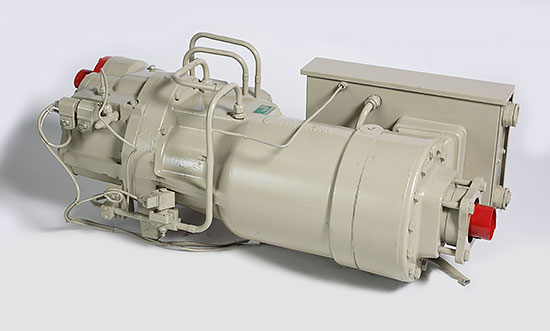
Screw compressors - engineered for performance
The easiest way to understand how a screw compressor works is to imagine that you’re drilling through a piece of wood with a household drill. A thin spiral of wood is drawn through the grooves of the drill - pulled from within the wood and moved out towards the base of the drill bit.
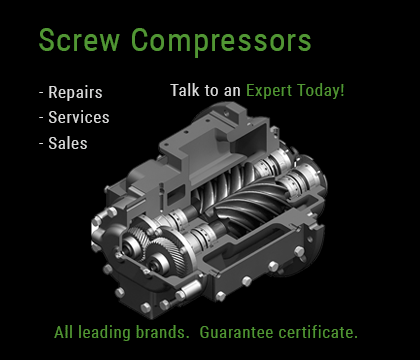
Screw compressors work in basically the same way but use two interlocking screws for greater efficiency. Instead of channelling wood along their grooves, these screws (or rotors) move gas through the compressor, creating the pressure needed.
In a typical screw compressor there are two screws (male & female) that are fitted together in stationary housing. As the rotors rotate, the gas is compressed by direct volume reduction between the two rotors. You do also get single screw compressors which rely on a single rotating screw passing through two star wheels to provide the compression.
Innovation behind the scenes
The original screw compressors were oil-free, or dry, machines. They ran at high speed to minimize internal gas bypassing and were very noisy. In the 1950s, oil-injected machines came in and found application in natural gas compression and refrigeration.
Capacity control on screw compressors is effected by the use of a slide valve which moves axially along the housing. They have good turndown, being able to operate at loads as low as 10% of the normal throughput. Another feature of screw compressors is that they can tolerate relatively large changes in suction pressure, a characteristic useful in refrigeration duties.
Screw compressors have the advantage over reciprocating compressors that they require no suction or discharge valves. By comparison with centrifugal compressors, the spares problem with screw compressors tends to be less severe. Since screw compressors are designed for oil-injection, they have some tolerance to a liquid slug, although continuous liquid slugging can cause problems.
A large proportion of the heat of compression in a screw compressor is absorbed by the oil. This characteristic may be advantageous if it is desirable to avoid high gas compression temperatures, as in cases where the gas may polymerize or explode if overheated.
Leading brands
All the leading brands worldwide, of which we support as OEM remanufacturers, manufacture Screw Compressors.
We carry plentiful stocks of high quality replacement parts supplied by these and other manufacturers. These spares are also used in our re-manufactured compressors, in order to maintain the standard of the original manufacturer.
A wide range of disposable refrigerants and consumables is also available to make sure that your compressors keep on running efficiently for years to come.
Our workmanship is guaranteed
Our repaired and exchange units carry the same one year warranty as the original manufacturer. We also offer an extended warranty.